Crazy: A Display Font That Brings Bold Character to Branding
There’s a moment in every branding project where you’re staring at a blank brand board, juggling keywords and client vibes, and you need a typeface that can instantly communicate personality. Recently, while sketching logo concepts for a small batch craft brewery, I found myself in that exact spot. The mood board was filled with vintage cans, hand-drawn illustrations, and a sense of playful nostalgia. The usual suspects—clean sans-serifs and sturdy serifs—felt too safe. I needed something with guts and a smile. That’s when I opened the font menu and clicked on Crazy.
The Instant Personality of Crazy
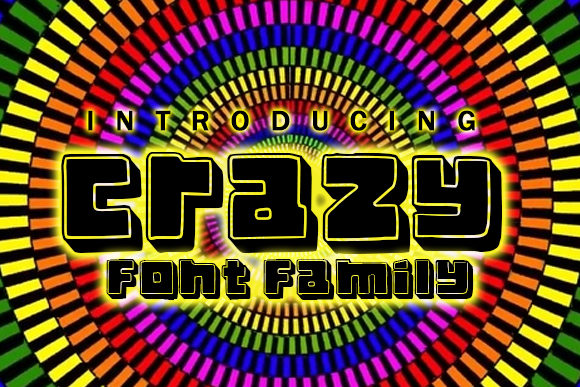
At first glance, Crazy is exactly what its name suggests: a bold, slightly irregular display font. But calling it merely “crazy” misses its nuance. The letters have a chunky, friendly solidity, with subtle variations in stroke endings that give it a handmade, almost brush-like quality without being a script. It’s not chaotic; it’s confident. The overall mood is energetic, approachable, and unpretentious. I dropped it onto my brewery logo draft—a simple wordmark—and immediately, the project had direction. That single word “Hops & Craft” suddenly looked like it belonged on a neon sign above a taproom door.
In practice, this personality is its greatest asset. For the brewery project, it conveyed craft and creativity without seeming too rustic or artsy. On a separate brand board for a modern skincare line aimed at a younger audience, Crazy, used sparingly on product names like “Glow Serum,” injected a dose of fun into a clean, minimal aesthetic. It’s that friendly feel the description mentions; it doesn’t shout, it enthusiastically invites.
Putting Crazy to Work Across Brand Assets
Testing a font in isolation tells you little. You need to see it in context. After the initial logo test, I pushed Crazy through a full suite of mockups.
Logos & Core Identity
For logo design, Crazy excels as a primary wordmark font for brands wanting standout character. Its bold weight ensures it holds space, making it perfect for main signage or app icons. On the brewery business card, the logo remained clear and impactful even at a small scale, though I’d advise keeping logo text relatively short for optimal clarity.
Packaging & Print
On packaging mockups, this is where a display font truly proves its worth. On a beer can label, the product name in Crazy dominated visually, creating a strong hierarchy against supporting descriptive text. It looked equally compelling on a bakery box mockup for a “Wild Sourdough” concept, giving a handmade shop a contemporary edge. It reads best at larger sizes, so it’s ideal for primary product names, headline slogans, or feature labels.
Digital Spaces
In web design, I placed it in a homepage hero section for a creative studio. The headline “Make Something Wild” in Crazy captured attention instantly, setting a tone before the user scrolled. For social media graphics, particularly Instagram posts or YouTube thumbnails, it’s a powerhouse. A single word or short phrase in Crazy becomes a graphic element itself, boosting engagement without extra illustration. Its bold forms are also highly legible on screens, even on smaller mobile devices.
Smart Limitations & Practical Pairings
No font is universal. Crazy is, unequivocally, a display font. Its bold, distinctive shapes are not designed for long body text. Attempting to use it for paragraph copy on a website or detailed product descriptions on packaging would harm readability and feel overwhelming. It’s a specialist, not a generalist.
This specialization means pairing it wisely is crucial. My most successful combinations paired Crazy with a very clean, neutral supporting typeface. For the brewery, a simple sans-serif for all descriptive text (ABV, ingredients, story) created perfect balance. For the skincare line, a lightweight geometric sans allowed Crazy to pop as an accent. It can also work beautifully with a classic serif for projects wanting a mix of traditional and energetic, like a local restaurant’s menu system where Crazy highlights specials.
When testing, always check its behavior in your specific software and outputs. Look at how it renders on your intended medium—a shop sign vinyl cut, a screen-printed tee, a glossy product box. Verify webfont availability and performance if using it online. If your project requires multilingual support, examine the character set to ensure it covers the necessary languages.
Who Should (and Shouldn’t) Go Crazy
Crazy is a fantastic choice for projects where personality is a primary brand pillar. Think:
- Creative studios, agencies, and freelance designers.
- Food & beverage brands (craft breweries, bakeries, coffee shops, juice bars).
- Skincare, cosmetics, and lifestyle products with a playful angle.
- Handmade shops, craft sellers, and artisan markets.
- Event posters, festival branding, and youth-oriented campaigns.
- Blogs, YouTube channels, and social media accounts wanting bold visual hooks.
It’s likely not the right fit for:
- Highly formal corporate identities (law firms, financial institutions).
- Projects where extensive, long-form readability is paramount (books, reports).
- Brands aiming for a minimalist, ultra-serious, or purely elegant aesthetic.
A Final, Practical Note Before You Download
Fonts are tools, and like any professional tool, understanding the license is key. Before committing Crazy to a final client project—be it a permanent logo, packaging that will be mass-produced, or a website template—verify its commercial licensing terms. Ensure your usage—client branding, merchandise, print-on-demand products—is covered. This protects your work and your client’s investment.
Ultimately, Crazy delivers on its promise of bold versatility. It’s a font that gets the job done by injecting character without requiring elaborate decoration. From a logo draft to a social media layout, it provides a consistent, friendly voice that makes creative ideas stand out. It’s not just a font named Crazy; it’s a practical choice for brands ready to show a little bold, interesting character.